The Church My Mother Chose (And the Faith I Had to Find for Myself)
On inherited religion, chosen faith, and what this Holy Week taught me
This is what I spent years trying to find my way into.
Not the building. Not the liturgy. Not the right dress in the right pew on the right Sunday morning. Something older than all of that. Something that has no interest in whether you’re doing it correctly.
I found it this week watching my four year old.
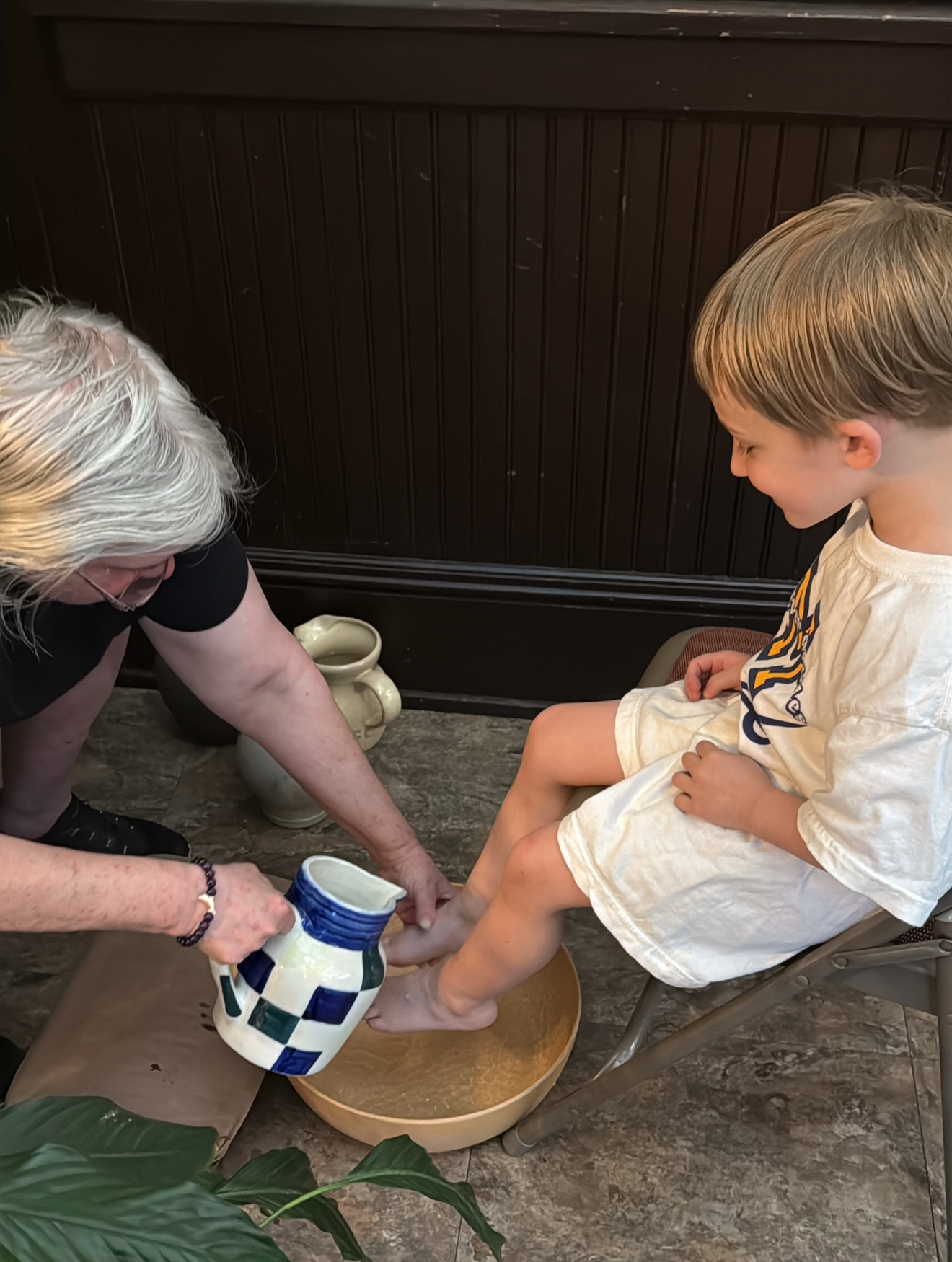
Candler didn’t hesitate at Maundy Thursday. While many grown Episcopalians likely shifted in their seats — wondering whether they were supposed to go up, whether it was optional, whether they’d do it wrong — my boy was already moving. Feet first. Literally. He wanted his feet washed, and then he wanted to wash feet, and there was not a single moment of self-consciousness in his entire body.
He didn’t know he was supposed to be shy about it.
He didn’t know that Episcopalians – people who will recite the entire Nicene Creed without blinking – sometimes can’t bring themselves to take off their shoes in front of a priest.
He just knew that something was happening, that it was good, and that he wanted in.
And I have been thinking about that moment ever since – through the foot washing, through the stripped altar, through the tears I couldn’t stop on Good Friday, through the silence of Holy Saturday, and into Easter morning.
Because that unselfconscious, uncomplicated willingness to just show up and receive? No performance. No propriety. No asking whether it’s the done thing?
That’s exactly what I spent years trying to find my way into.
Just grace. Feet first.
I grew up Episcopalian.
That sentence means something different depending on who’s saying it. For some people, it means smells and bells and the liturgy written on their bones before they could read. For others – and honestly, for me, for a long time – it meant Sunday mornings in the right dress, in the right pew, in the right church. The one your grandparents went to. And their grandparents before them. Not because anyone sat down and chose it, but because that’s simply what our people did.
My mother went to the Episcopal church because it was the socially correct thing to do. I had suspected this for a while – there was something in the way she wore her faith, the way it fit like a good coat rather than something that had changed her from the inside. But it wasn’t truly confirmed until recently, when we were planning my grandmother’s funeral and I simply asked her.
She told me plainly. The church wasn’t chosen – it was inherited. And when her parents briefly left, she left too. Just like that. The faith was never really the anchor. The people around her were.
I don’t say that to be unkind to her – I say it because it’s true, and because I think more of us grew up in that version of church than we’d like to admit. The church wasn’t a place you went to be transformed. It was a place you went to be seen. To be confirmed. To be buried. To fulfill the obligations that good Southern families of a certain stripe had always fulfilled.
(There’s a footnote to my own story here worth mentioning: I was actually baptized in the Anglican church that my dad and his mother – my grandmother – started. But that’s a story for another day.)
And I walked in it. For years, I just walked in it – the way you walk the halls of a house you grew up in without ever really looking at the walls.
I had good ministers. Genuinely good ones. Men and women who were saying true things from those pulpits. But I wasn’t ready to hear them yet, because I hadn’t chosen to be there. At least, not in the way I hear it now. The way one does when they haven’t really lived life just yet. I was just… there. Inherited. Present in body, somewhere else entirely in spirit.
It wasn’t until I left – until I stepped out of the church I had simply been born into – that I started to actually get it. After so many years of being wrung through the ordinary and extraordinary bumps of life.
This week, sitting in a Maundy Thursday service I never once attended as a child – not because they didn’t exist, but because my mother never chose to go, I assume- I felt all of it rise up at once. What it means to inherit a faith versus what it means to claim one. The difference between walking into a church because your grandmother did, and walking into one on a Thursday night in Holy Week because something in you needs to be here.
Nobody comes to Maundy Thursday by accident.
There’s something achingly ironic about it, isn’t there?
I spent the first half of my life sitting in church the way Candler ran around impatiently at moments this week – present, fidgety, wanting to know what was going on and why it was – but never quite sure what any of it was for. And now I watch my four year old throw himself into the holiest moment of the Maundy Thursday liturgy like it’s the most natural thing in the world, because for him, it is. Nobody has taught him yet to be dignified about grace. Nobody has told him that church is something you receive quietly, with your hands folded and your heart at a careful distance.
He doesn’t know that faith can become a performance.
He doesn’t know that you can spend decades inside a church and never actually let it touch you.
I knew. Or rather – I learned. Slowly, the way you learn things that are absorbed rather than taught. I learned that church was about being seen in the right place. That Easter mattered more than Holy Week. That you could skip Maundy Thursday entirely and no one would notice or mind, because the people who went to church for the right reasons weren’t really keeping score of the Thursday services anyway.
My mother didn’t take me to Maundy Thursday. Her mother probably didn’t take her. And I don’t hold that against either of them – I hold it gently, the way you hold something you’ve finally started to understand. They gave me the structure. The liturgy in my bones, the prayers I knew before I knew why I knew them, the rhythm of the church year even when we only observed the highlights. That was a gift, even if it was an incomplete one.
But the faith underneath it – the real thing, the foot-washing thing, the stay and watch with me thing – that I had to go find on my own.
I had to leave the church I grew up in to find out why I believed what I said I believed.
I had to choose it.
And the choosing didn’t happen on a Sunday morning in a pretty dress.
It happened when I was broken.
Broken in the kind of way that doesn’t show on the outside – the kind where you move through your days and smile at the right moments and nobody knows that somewhere underneath all of it, you have stopped believing you are worthy of love. Of life itself. I was in that place. Low in a way I hadn’t known was possible, hollowed out by things I’m not sure I have full words for even now.
And then one day I heard Bishop Alexander speak at Christ Church.
I couldn’t tell you exactly what he said. I couldn’t reconstruct the sermon for you word by word. What I can tell you is that something happened in that room – something that was not about me at all and entirely about me at the same time. The weight I had been carrying, the weight I had started to believe was just mine to carry forever, lifted. Physically lifted. Like something was set down that I hadn’t even fully realized I’d been holding.
That was the day I was saved. (You can read the whole story here.)
Not saved in the way I’d been taught to think about salvation – not a transaction, not a prayer recited correctly, not a box checked on the way to something else. Saved in the way that means found. Saved in the way that means the lights came on. Saved in the way that means I stopped being a passenger in my own faith and started being a participant.
And from that moment, I began -slowly, imperfectly, with a lot of backsliding and circling and sitting in parking lots crying in ways that would embarrass me to describe – to break open. Spiritually. The way a seed breaks open in the dark before it knows it’s going to become something.
I began to move toward the light.
Not because I suddenly had all the answers. Not because the hard things got easier or the questions got quieter. But because I had felt, in one unrepeatable moment, that I was not alone in any of it. That grace was not a concept. That God was not a tradition.
That love -real love, the kind that doesn’t require you to be worthy first – was raw. Real. Bare.
This was the Great Triduum. And I could not move through them this week without sitting with the weight of what they mean, not just personally, but in the world as it actually is right now.
Good Friday.
Pilate knew. That’s the part that stays with me. He knew Jesus was innocent. He tried to release him — said so plainly, more than once. And the crowd demanded otherwise, invoking law and justice and the weight of their own outrage. And Pilate gave in. Not because he believed they were right. Because he was afraid of them.
How many of us have done the same?
Not driven the nails ourselves. Not shouted with the crowd. But stood at the edge of something wrong and said nothing. Signed off. Looked away. Let it happen because the cost of stopping it felt too high. We tell ourselves we weren’t the ones who did it. But Pilate told himself that too, and he washed his hands in front of everyone, and it didn’t change a thing about what his silence had permitted.
And I think most of us – if we are truly honest – are not the crowd. We are Pilate. We are the middle. The moderate. The ones who know better, who can see clearly enough to be uncomfortable, but who do not act. Who find reasons. Who weigh the cost. Who decide that this particular moment is not the right moment, that this particular hill is not worth dying on.
Martin Luther King Jr. wrote from a Birmingham jail that he had come to believe the white moderate was a greater obstacle to justice than the outright extremist. Not because the moderate was crueler – but because the moderate was comfortable. Because the moderate preferred order to justice. Because the moderate was always willing to wait – for a better time, a better method, a better messenger – and that waiting was itself a choice. A choice that kept the machinery running.
Pilate preferred order to justice too.
He knew. And he waited. And he washed his hands. And Jesus died anyway.
Pilate. The Pharisee. The white moderate.
They are the same person in different clothes in different centuries. The costume changes. The calculus does not. Know the right thing. Fear the cost. Choose comfort. Call it wisdom.
The moderates of every age have clean hands and clean consciences – because they tell themselves they are simply following the law. The question this Good Friday was not whether we are capable of the crowd’s cruelty. Most of us are not. The question was whether we are willing to be something more than Pilate.
Whether we will do more than wash our hands and walk away.
And then there is this: the crowd that demanded his crucifixion also demanded efficiency. It was the day of Preparation. The sabbath was coming – a high and holy day – and bodies could not hang on crosses through it. So they asked Pilate to have the legs of the crucified men broken, to hasten their deaths, so that everything could be tidied away before sundown and the holy day could begin properly.
The holy day. The rules. The schedule.
They broke the legs of the men on either side of Jesus. But when they came to him, he was already gone. So they pierced his side with a spear instead, and blood and water poured out, and scripture was fulfilled: not one of his bones shall be broken.
I keep turning that over. The same people who had just orchestrated the execution of an innocent man were deeply concerned about observing the sabbath correctly. The same crowd that called for crucifixion wanted to make sure they were home in time for the holy day. The law was sacred to them. The rules were sacred. The appearance of righteousness was sacred.
The man dying on the cross was not.
It is what the Pharisees had done so often throughout his ministry – straining out gnats while swallowing camels, as Jesus himself said. Tithing their herbs with meticulous precision while neglecting justice and mercy and faithfulness. Keeping the letter of the law so carefully, so publicly, while missing the entire point of it.
Religion as performance. Holiness as reputation management.
Sound familiar?
It should. It is as old as the temple and as current as this morning’s news. The impulse to look righteous while doing harm – or permitting it – is not a first-century problem. It is a human problem. It is the thing that put Jesus on the cross and then hurried home to light the sabbath candles.
And then Good Friday ended the way it should – not with a hymn of triumph, not with a tidy resolution, but with a question.
Were you there when they crucified my Lord?
I could not stop my tears.
That song was not written by the powerful. It was not written by people who had the luxury of observing the crucifixion from a comfortable theological distance. It was written by enslaved people – people who knew in their bodies what it was to be crushed by an unjust system, to watch the innocent suffer, to be powerless against the machinery of cruelty dressed up as law and order. They looked at the cross and they did not see a distant historical event. They saw their own lives. They sang it from the inside.
Were you there when they nailed him to the tree?
And the answer, if we are honest – if we are really, truly honest – is yes. We are always there. We are there every time we look away. Every time we let the crowd decide. Every time we prioritize our holy day over the human being dying in front of us. Every time we break the legs and go home to light the candles and call it righteousness.
The song doesn’t let you off the hook. It doesn’t allow you to place yourself among the weeping women or the beloved disciple. It just asks: were you there?
And it causes me to tremble.
Tremble. That word is in the song for a reason. Not because the answer is shameful beyond recovery – but because it should move us. Because a faith that doesn’t make you tremble at the cross isn’t really reckoning with what the cross means.
The people who wrote that song reckoned with it. They had no choice. And in their suffering they gave the rest of us a gift we have not always deserved — a way to enter the grief honestly, without armor, without performance.
Feet on the ground. Tears on the face.
Were you there?
I looked at our altar, stripped and bare as it always is on Good Friday – the linens gone, the candles extinguished, the tabernacle open and empty. It is one of the most honest things the church does all year. No adornment. No performance. Just the bare truth of what that day is.
And I thought about the churches – not mine, but some – where an American flag stands near that altar. Where the symbols of a nation share space with the symbol of a man who carried no flag. Who claimed no country. Who died under the banner of an empire that killed him, and whose kingdom, he said plainly, was not of this world.
Jesus carried no flag. He marched under no nation’s colors. He did not die for a border or a policy or a political coalition. He died because the powerful were threatened by a truth they couldn’t contain.
This Holy Week, Pope Leo XIV stood before tens of thousands in St. Peter’s Square and said what needed saying. Drawing from the prophet Isaiah, he declared that Jesus “does not listen to the prayers of those who wage war, but rejects them” – and that God says plainly: your hands are full of blood.
He said it without hedging. Into a world where leaders on every side of every current conflict have wrapped their violence in the language of God.
And there we were on Good Friday, praying the Prayers of the People – and in those prayers, as we always do, we prayed for our leaders. Including our president. A man whose decisions have contributed to the deaths of children. A man whose hands are, by any honest accounting, stained.
And yet we prayed for him.
I know some friends find this troubling- but I think I understand it differently. We are not praying in endorsement. We are not blessing what has been done. We are praying – desperately, honestly – for his better angels. For the part of him that might still turn toward something true. We pray because that is what we do with people we cannot fix and cannot stop and cannot reach: we bring them before the God who can.
And then I thought of the children in Dilley.
The detention center in Dilley, Texas – one of the largest in the country – where migrant children sit behind fences, waiting. Small people caught in the machinery of policies made by large people who will never meet them. Children who did nothing except be born somewhere desperate enough that their parents risked everything to leave.
But it isn’t only helplessness that put them there. That’s what I keep coming back to.
Pharaoh didn’t order the killing of Hebrew sons because he was indifferent to them. He ordered it because he was afraid of them. Afraid of what they might become. Afraid of the power they might grow into, the numbers they represented, the future they embodied that he could not control. The infant Moses floated in a basket on the Nile because a powerful man looked at a population of children and saw a threat.
Herod did the same. The slaughter of the innocents – every male child two years and under in Bethlehem – was not cruelty for cruelty’s sake. It was fear dressed up as policy. A king so threatened by the possibility of what one child might become that he was willing to kill them all to prevent it.
And the children in Dilley. Locked away not because of what they have done, but because of what they represent – the possibility of them, the future of them, the sheer number of them and where they come from and what their presence might mean for people who are afraid of a country that looks different than the one they think they were promised.
It is the oldest story in scripture. Power has always feared the innocent – and the message they bring.
And God has always been found among them.
And I thought of Mary.
I thought of what it is to be a mother and watch your child suffer and be able to do nothing. Mary had carried him. Birthed him. Nursed him, held him, dried his tears, watched him sleep. She had known him before he knew himself. And now she stood at the foot of a cross, and her entire soul was breaking open – and she stayed. She did not look away. She did not leave.
I don’t know how she bore it.
And yet – she knew. On some level, in some deep and terrible place of faith, she knew it had to happen. That this was the thing she had been told about, the sword that would pierce her own soul too, as Simeon had warned her all those years before in the temple when he was just eight days old and she was still learning what it meant to be his mother.
She held both things at once: the agony and the knowing. That is not a small thing. That is one of the hardest things a human soul can do.
And then I thought of the women.
It has always been the women who knew first.
Hagar – alone in the desert, cast out, certain she and her son were going to die – and God found her there. Not in a temple. Not in a seat of power. In the wilderness, beside a spring, with a child she thought she was about to lose. And she named God. El Roi. The God who sees me. She is the first person in all of scripture to give God a name, and she was a woman, an outsider, a slave, someone the powerful had discarded.
Mary and her cousin Elizabeth – both of them carrying impossible promises in their bodies – and when they found each other, the baby in Elizabeth’s womb leaped. The recognition happened before any of them could speak a word of explanation. The truth announced itself, body to body, mother to mother, before the world had any idea what was coming.
The women at the tomb. They went first. They went while it was still dark. And they were the ones who found it empty, who heard the news, who were sent to tell – and the male disciples, scripture tells us plainly, did not believe them. Thought it was an idle tale.
It was not an idle tale.
It has never been an idle tale.
The women have always been the first to see. The first to go. The first to name what is true in the face of a world that would rather not hear it. They have been disbelieved and dismissed and told to be quiet and sent back to their proper places – and they have spoken anyway.
That is the lineage we carry.
And here’s what I know now, on this Easter morning, having watched my son dry someone’s feet with the same focused joy he brings to everything he loves – having sat in the dark of Good Friday and felt the weight of all of it – having come through Holy Saturday’s silence and arrived at the empty tomb:
You can’t inherit that. Not really. The building can be passed down. The prayers can be passed down. The tradition, the liturgy, the beautiful ancient choreography of it – all of that can be handed to you like good china.
But the willingness to take off your shoes?
That part you have to come to yourself.
If you’re sitting in a church you didn’t choose – or one you chose because it was easier than explaining yourself, or one you’ve been attending out of habit or obligation or the vague sense that showing up counts for something – I’m not here to tell you to leave.
I’m here to tell you that there’s more.
Not more church, necessarily. Not a different denomination or a better choir or a pastor who finally says the thing you needed to hear. Sometimes it is that. Sometimes leaving is exactly right, and the act of walking out one door is what finally opens another. But sometimes the leaving is internal. Sometimes it’s the moment you stop performing and start receiving. Sometimes it’s a Thursday night in Holy Week when you could have stayed home, when nobody would have known or judged you either way, and you went anyway because something pulled you there.
That pull? That’s the thing worth following.
I spent years being in church without being of it- and I had no idea. Going through the motions of a faith I had inherited but never really tried on for myself. And then, slowly – through leaving and returning, through good ministers whose words finally landed in soil that was finally ready, through grief and questions and seasons where I wasn’t sure what I believed about any of it – it became mine. Some of this was because I explored it more. Some of this was simply what happens when we grow up. We come into our own faith.
Not my grandmother’s. Not my mother’s. Not the socially appropriate thing to do on Sunday mornings.
Mine.
And now I sit in Maundy Thursday services that nobody required me to attend, in a faith I chose with my eyes open, next to a four year old who doesn’t yet know that any of this is supposed to be complicated.
Maybe that’s the whole point.
Maybe the inherited faith, for all its limitations, plants something. And the chosen faith is what happens when that seed finally cracks open – when you stop walking through the house you grew up in and start actually living there. When you trade the performance for the presence. When you take off your shoes.
When you stop asking if you’re doing it right and just let the water run over your feet.
That’s when church stops being something you attend and starts being something you are.
So here is my challenge to you this Easter Sunday.
Speak truth to power.
Not with a sword – Jesus told us to put those away. Not with cruelty, not with contempt, not with the self-righteous fury that feels like courage but is really just noise. Pilate had plenty of noise around him. It didn’t make anyone brave.
Speak it with boldness. The kind that comes not from certainty that you’ll win, but from certainty that the truth is worth saying regardless. Jesus walked into Jerusalem knowing what was waiting for him. He went anyway.
Speak it with kindness. Because the people who most need to hear hard things are the least likely to receive them wrapped in anger. Kindness is not weakness. It is the most disarming thing in the world.
Speak it with love. For God is love. Not a concept of love, not a feeling of love – love as the very nature and substance of the divine. And Jesus is that love made flesh, made vulnerable, made a story that ends in death and then – impossibly, gloriously – doesn’t.
That is what this weekend was. It is the ultimate story of what love is willing to do. Love that washes feet. Love that prays for its enemies. Love that stands between the powerful and the innocent and says: not like this. Love that is killed for saying so, and rises anyway.
We are resurrection people. And resurrection people do not stay silent.
Hagar spoke in the wilderness. Mary said yes in the dark. The women ran from an empty tomb to tell a story nobody wanted to believe.
And they were right.
So take off your shoes. Let the water run. And then go speak.
He is risen.